

What Are Some Examples of Successful Creator Apps?
Updated January 30, 2026
Most creators believe building a mobile app means hiring developers, spending $30,000+, and waiting six months. That used to be true. Today, you can launch iOS, Android, and web apps in four to eight weeks using no-code platforms while keeping your content, community, and payments under one roof.
This article walks through 10 real creator apps across fitness, wellness, arts, and coaching. For each, you'll see the niche, the problems solved, the features used, and the outcomes reported.
What Is a Creator App?
A creator app is a branded mobile and web application you own. It combines courses, community, and payments in one place. Unlike hosting on social media or renting space on a marketplace, you control the entire member experience from onboarding to renewal.
Moving from "rented land" to "owned assets" solves three chronic problems. First, algorithms hide your posts from followers who already paid you. Push notifications reach 20% of users on average, with transactional push reaching 69%, while email open rates average 42% to 43% across industries. The combination of both channels gives you more ways to reach members. Second, managing DMs, a Facebook group, Zoom links, and a separate course platform creates support chaos. Third, one-time course sales create feast-or-famine cash flow. Subscriptions and memberships inside an app stabilize monthly recurring revenue.
Creators report completion rate increases of 15% to 30% within 90 days when they add push notifications and weekly challenges to their apps. The difference isn't the content, it's the container.
Fitness and Wellness App Examples
Results Earned by Tiffany Wilkerson
Tiffany Wilkerson ran a fitness coaching business but hit a ceiling with one-on-one training. She couldn't scale her time, and clients who wanted structured programs had to settle for PDF plans and email check-ins.
She built Results Earned as a six-week training app with drip content, progress tracking, and an in-app community. The app replaced scattered tools and gave clients a clear start-to-finish path. Her challenges are priced at $400+, and push reminders keep clients on track between sessions.
"I have really enjoyed creating my passion app over the past year and half. I would not have been able to make my idea for an app come to life without the platform passion provides." - FitwithBrit on Trustpilot
The Portal App by Savannah Bohlin
Savannah Bohlin previously hosted her holistic health and fitness programs on a web-first platform that felt clunky on mobile. Clients asked for personalized workouts and meal plans they could access during gym sessions, but the existing setup required clients to bookmark three different URLs and remember two sets of login credentials.
She moved The Portal to a branded mobile app with personalized workout plans, meal planning tools, and community features. Offline mode means clients can follow workout videos even when Wi-Fi drops in the gym. Push notifications remind members to prep Sunday meals and join live Q&A sessions.
Fit in Twenty by Ellen Decker
Ellen Decker built a 65,000+ Instagram following as a model and personal trainer, but monetizing that audience through DMs and Stripe links felt chaotic. She needed a way to deliver quick, effective workouts to hundreds of members without live Zoom calls eating her calendar.
She launched Fit in Twenty, a mobile app focused on 20-minute workouts. The custom-branded experience matches her visual identity, and the app became the foundation of her business growth during the pandemic when in-person training stopped. The app's timer and progress tracking features turn standalone videos into a structured program.
BarstarzzBTX by Ed Checo
Ed Checo needed a platform that could handle hundreds of workouts with comprehensive tracking for serious athletes. Spreadsheets and YouTube playlists didn't cut it for members training six days a week.
BarstarzzBTX features hundreds of workouts, interactive workout tracking, meal plans, progress photos, and multiple membership tiers. Members can follow beginner, intermediate, or advanced programs, and the app tracks reps, sets, and personal records over time. The app currently sells for $19 per month.
Arts and Skills Training App Examples
Bakerlou Music
Music teachers face a unique problem: students need to practice between lessons, but PDFs and email attachments don't create accountability or track progress. Louisa Baker needed a flexible platform where students could access lessons remotely and log practice sessions.
The Bakerlou Music app delivers personalized music lessons accessible wherever and whenever students want. Video lessons walk through technique, and students can replay sections at their own pace. The app's offline mode means students can practice in basements or studios without Wi-Fi. Push reminders nudge students to practice daily, and the in-app community lets them share recordings and get feedback.
Allie Cooper Aerial Arts
Allie Cooper coaches circus and aerial arts, a niche with a small but passionate audience scattered globally. Finding aerial students in one city limits growth, but online programs need video quality and the ability to break down complex movements frame by frame.
Allie Cooper Aerial Arts focuses on getting aerial artists back in the air after taking a break from the profession. The app walks through progressions for silks, trapeze, and lyra with slow-motion breakdowns and conditioning routines. The specialized content and mobile-first delivery let Allie serve students worldwide without geographic limits.
"I am so excited to be a part of the Passion.io community... this approach makes it affordable, easy, fun and really quick to do!" - Jane Mullins on Trustpilot
Business and Coaching App Examples
Fitness Coaching with Tiered Subscriptions
Fitness coaches often need tiered subscription models to serve clients at different commitment levels. Apps with multi-tier pricing allow entry-level access alongside premium coaching without managing multiple payment systems. Monthly plans can range from basic workout libraries to premium tiers with nutrition coaching and one-on-one check-ins. Push notifications announce new challenges and remind members to book their monthly coaching calls, which improves retention.
SmartWorkout
SmartWorkout started as an ecommerce brand selling fitness equipment. They realized that teaching customers how to use the gear properly would reduce returns and build a loyal community around the brand.
The SmartWorkout app delivers video tutorials and educational content in English and French. The app doesn't replace product sales, it increases the value of each purchase by turning buyers into educated, engaged users. SmartWorkout has attracted over 25,500 users and generated €163,000+ in annual revenue through €5 lifetime access plans. Push notifications share new tutorials and technique tips.
Hospitality Concierge by Mandy
Hotel owners and boutique B&B operators struggled during the pandemic with operations and guest experience. Mandy saw an opportunity to package her hospitality expertise into a resource hub that owners could access 24/7.
Hospitality Concierge is a one-stop shop app for boutique hotels and B&Bs with marketing strategies, operations checklists, and sales support. Members get templates, workflows, and community advice from other hospitality professionals. Push notifications highlight seasonal strategies and remind members to implement monthly action items.
"Setting up my coaching app on Passion.io has been one of the easiest and most intuitive processes I've experienced... everything is housed in one place—content, communication, client access, design—and it's all optimized to save time while delivering a high-quality user experience." - Everchanging Butterfly on Trustpilot
Learn Swahili Now by Karen Stringer
Language educators need learners to practice daily, but email reminders get ignored and Facebook groups lose momentum. Karen Stringer wanted a mobile-first solution that made Swahili lessons feel accessible and fun.
Learn Swahili Now uses short video lessons, quizzes, and community features to build daily learning habits. The app's offline mode lets learners study during commutes or flights, and push reminders nudge them to complete their daily lesson streak. The in-app community lets learners practice conversational Swahili with peers.
You can see more examples and explore Passion.io's platform demo to understand how these features work together. Additional use cases for health and fitness professionals highlight similar success patterns across niches.
What Do Successful Creator Apps Have in Common?
Three patterns emerge across these examples. These aren't random wins, they're repeatable strategies that work across niches.
1. Push Notification Strategy
Creators who treat push notifications as a retention tool see measurable completion lifts. Push notifications achieve an average 20% open rate, with transactional push reaching 69%. Send welcome nudges after signup, mid-challenge check-ins, and celebration messages after milestones to keep members moving without feeling spammy.
2. Community Integration
Moving the conversation out of Facebook and into your app increases engagement and protects you from platform risk. Facebook algorithms hide posts from your own group members, and you don't own the contact list if the platform changes policies.
Apps use in-app community features where members post progress photos, ask questions, and support each other. The community tab lives next to course content, so members naturally engage while consuming lessons. Building a community inside your app also consolidates your support load because members answer each other's questions.
3. Simple Pricing
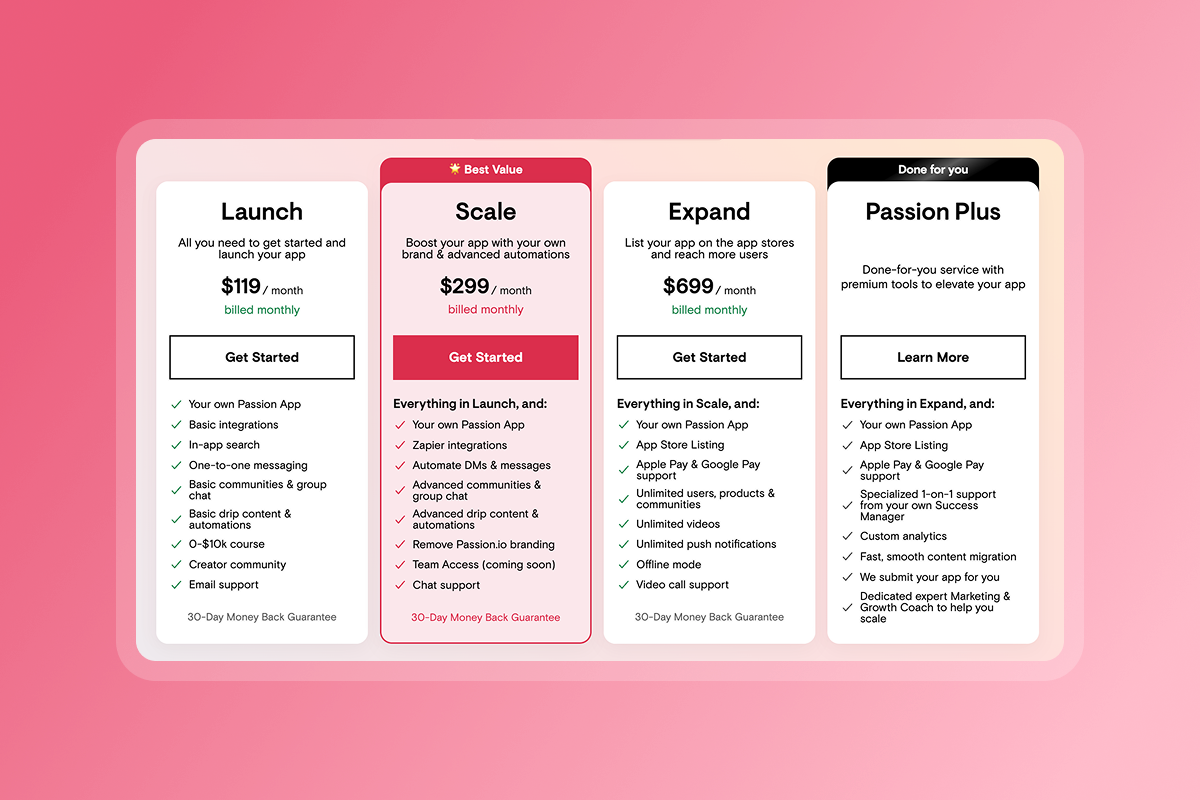
Successful apps use clear subscription tiers: monthly, annual, or smart one-time offers. Complex pricing with multiple add-ons creates decision paralysis. Simple tiers with clear value at each level let members self-select and upgrade naturally. Interactive courses and mobile learning become easier to sell when the pricing structure is transparent.
"Easy, Friendly staff and lots of support... Clients of mine from the first launch said it was a fun and easy app to use. The customer support staff are very helpful and respond very fast, they helped me navigate the Apple/Google sites to get the app live with no hesitation." - Natalie Gidas on Trustpilot
How to Choose the Right Creator App Platform
Choosing between custom development, a web-only LMS, or a no-code app builder comes down to cost, time, and ownership. Here's how the three paths compare:
The Checklist
When evaluating a no-code app builder, confirm these points:
Does it offer iOS and Android? You need native mobile apps to use push notifications and offline mode effectively.
Are there hidden fees? Transparent platforms publish their payment processing fees upfront. PassionPayments charges 3.9% on web checkouts plus standard Stripe fees. Apple and Google take 15% to 30% on in-app purchases depending on your revenue and program eligibility.
Is there support for App Store submission? Apple requires a $99/year developer account and Google charges $25 one-time. Some platforms handle submission for you on higher tiers, others provide step-by-step guidance. Check Apple's review process expectations and Google's health and fitness compliance requirements before you start.
Can you sell on your website to avoid Apple fees? External payment options processed outside the app store avoid the 15% to 30% cut. Route web purchases through your own checkout and grant app access via login.
Comparing fitness app builders and alternatives helps you see where different platforms excel. If you're moving from a web-first LMS, read the Passion vs Teachable comparison to understand the shift from online courses to branded apps.
Ready to Build Your Creator App?
Push notifications drive completion, community increases retention, and simple pricing converts browsers into subscribers.
We give you the same tools these creators used with iOS, Android, and web apps that include push notifications, community features, and flexible payment options without hiring developers. Your web app can launch in two to three weeks, and you can have app store submissions underway by week four.
Watch the platform demo to see how the builder works, or explore the welcome video to understand the process. The PassionFighters community connects you with other creators who are building and launching right now.
Understanding LTV, CAC, and payback periods for your app helps you forecast profitability and plan growth. Join the Creator MBA program to learn the business strategy behind successful creator apps.
Stop renting your audience from platforms that can change the rules overnight. Build an app you own, reach members when it matters, and create predictable recurring revenue from your content. Check out Passion.io in a 30-day money back guarantee demo!
Frequently Asked Questions
How long does it take to launch?
Your web app can go live within two to three weeks of starting. Most creators have fully published iOS, Android, and web apps within four to eight weeks of signup.
Do I need a developer account?
Yes. You need an Apple Developer Program membership at $99/year and a Google Play Developer account at $25 one-time.
Can I sell on my website to avoid Apple fees?
Yes. Web checkout charges 3.9% plus Stripe fees, and you pay 0% to Apple or Google because the sale happens outside the app. Most creators use web checkout for core subscriptions and reserve in-app purchases for convenience upsells.
You can explore 8 must-know tips for your next program launch to plan your go-to-market strategy. Learning how to track your audience's app movements helps you measure engagement and optimize retention.
"I stepped into Passion.io because I chose a platform that creates structure around my content and supports the way my services evolve... I feel a genuine excitement as I build this out." - Thea White on Trustpilot
Key Terms Glossary
Native app: An iOS and Android app installed directly on a device, not just a mobile-responsive website. Native apps access push notifications, offline storage, and home screen placement.
Push notification: A direct message sent to a user's home screen that appears even when the app is closed. Push notifications achieve an average 20% open rate, with transactional push reaching 69%.
IAP (In-App Purchase): Digital content or subscriptions purchased inside a mobile app through Apple's App Store or Google Play's billing systems. Apple and Google take 15% to 30% of IAP revenue depending on your program eligibility.
Churn: The percentage of subscribers who cancel each month. Lower churn means higher lifetime value and more predictable monthly recurring revenue.
MRR (Monthly Recurring Revenue): Predictable monthly income from subscription-based memberships, calculated by multiplying active subscribers by average subscription price.
No-code: A software development approach allowing creators to build functional apps using visual interfaces and pre-built components, eliminating the need for traditional coding or developer teams.

Build the business
behind what you know.
Turn your expertise into a branded app with courses, community, and the You AI Coach. Launch plan from $99/month.