.png)

Updated January 29th, 2026
A $99-per-month platform fee feels like a big commitment when Facebook groups cost nothing and email marketing seems cheaper. The real question is not what a branded app costs, but what continuing without one is already costing you in lost members, scattered tools, and revenue that spikes on launch day then bleeds away.
The conversation shifts when I walk through the actual numbers with coaches. You're not buying software. You're buying back the members you're losing to low engagement and tool friction.
Is a Creator App Worth the Investment?
A creator app is a branded mobile and web platform where you publish courses, host community discussions, send push notifications, and process payments under your own name. Unlike a Facebook group or a web-only course site, your app lives on members' home screens with your logo and brand.
The hidden cost of "free" platforms compounds over time. Email open rates in education average 23.4%, and Apple's Mail Privacy Protection has inflated open metrics by 18 points since late 2021, making them unreliable for measuring true engagement. Social algorithms change without warning, throttling organic reach overnight.
Ownership means paying for infrastructure, but it also means no one can revoke your access. When you own the app, you own the data export, the member list, and the ability to reach people directly. The real comparison is predictable access versus rented land where the landlord changes the locks.
Platform dependency creates risk that most creators underestimate until it hits them. Algorithm updates can cut organic reach by 50% or more in a single quarter. One creator I spoke with saw her Facebook launch posts reach 75% fewer people in late 2024 compared to earlier that year. She moved to a branded app with push notifications and rebuilt consistent engagement because she could reach every member directly instead of depending on algorithmic distribution.
Revenue Lift: How Mobile Features Compound Income
Revenue grows when you keep the members you already have and make it easy for them to buy more. Mobile-first features drive both.
The Retention Multiplier: Push Notifications vs. Email
Email open rates in education average 23.4%, and click-through rates hover around 3%. Push notifications average a 7.8% reaction rate overall, jumping to 14.4% for contextual campaigns. More importantly, push notifications appear on lock screens, so your member sees "New workout posted" or "Challenge starts tomorrow" without unlocking their phone. 77% of people engage with push notifications monthly, and 60% report using apps more frequently because of them.
Higher visibility leads to higher completion. According to documented case studies, a fitness coach moved a 30-day challenge from Facebook and Zoom into a Passion app with push notifications twice weekly and an in-app accountability channel. Lesson completion jumped 22% in 9 weeks, and monthly churn dropped from 8% to under 6%. The coach credited push notifications and offline lesson downloads for the lift.
Completion drives renewals. A member who finishes your program is far more likely to buy the next one. Low completion is silent churn. You don't see it immediately, but three months later, renewal rates collapse. Push notifications close that gap by nudging members back into the app at the moment they need a reminder.
When churn drops from 10% monthly to 5%, your average member lifetime doubles from 10 months to 20 months. At $29/month, lifetime value increases from $290 to $580 per member. Multiply that by 50 members, and you've added $14,500 in total LTV across your member base.
Monetization Flexibility: Subscriptions and In-App Purchases
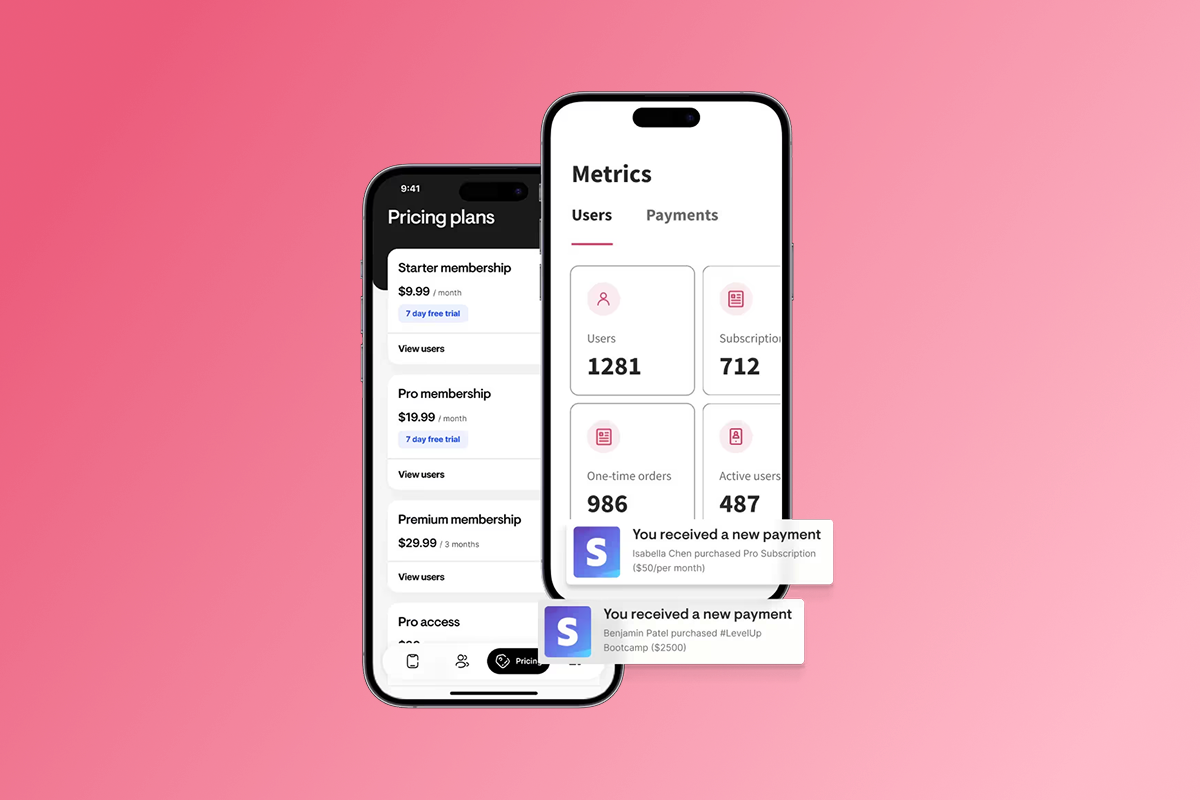
Revenue stability comes from recurring subscriptions rather than one-time course sales that create launch spikes and valleys. Passion.io supports subscriptions (weekly, monthly, annual), one-time purchases, freemium tiers, and trials of 3-30 days. You can offer a free intro module, then charge monthly for the full library.
Payment pathways matter for margin because fee structures vary significantly:
A $29 monthly plan loses $4.35 to Apple's 15% In-App Purchase fee but only $1.97 via web checkout. The hybrid model lets you optimize: use web checkout for high-ticket offers and annual subscriptions where margin matters, and enable IAP for convenience and impulse upsells where one-tap mobile checkout drives higher conversion despite the fee.
Market your annual plan via email and social with a web link. Enable IAP for monthly subscriptions so mobile users can join without leaving the app. On Scale, Expand, and Plus plans, you can process external payments through ThriveCart or SamCart at 0% Passion platform fee, paying only your processor's rate.
The diversification reduces dependency. If Apple changes policy, you still have web revenue. If web traffic dips, mobile IAP keeps subscriptions flowing.
Cost Savings: Eliminating Tool Sprawl and Admin Drag
Revenue lift is half the ROI equation, and the other half is what you stop spending.
Most coaches juggle a course platform, a community tool, video hosting, email marketing, automation software, and calendar booking. Each subscription adds up. When you consolidate into one app platform, you often cancel multiple subscriptions immediately.
Passion.io bundles courses, community, video hosting, push notifications, and payment processing into one platform starting at $99/month on annual billing. If you cancel redundant tools worth $100-150/month, your net platform cost drops significantly or reaches zero before you count engagement gains.
Time saved matters as much as dollars saved. Every support ticket asking "Where do I find the lesson link?" or "Why didn't my payment go through?" takes your attention away from coaching. When content, community, and billing live in separate systems, friction multiplies. A member logs into your course site, switches to Slack for discussion, then clicks a Stripe link to renew. Each step is a chance to drop off.
One app reduces friction. Members open your app, see the new lesson, comment in the community thread, and tap "Renew subscription" without leaving. Support load drops because fewer things break.
"Absolutely LOVE the Passion.io app platform. Everything you need to build and launch your app. They make it so easy and customer support is awesome!" - Shannon Reissman on Trustpilot
The app doesn't just save money; it buys back your time to focus on coaching and content creation instead of troubleshooting integrations.
Total Cost of Ownership: Passion.io vs. Custom Development
Mobile app development costs hit a new high in 2025, averaging $171,450 for custom applications. Development timelines typically run 20-40 weeks for complete applications. After launch, maintenance costs add another 15-25% of the original development cost annually, covering bug fixes, OS updates, and hosting.
For a solo coach or small team, those numbers eliminate custom development as an option. You'd spend months defining specs and testing builds. If something breaks post-launch, you're paying a developer by the hour to fix it.
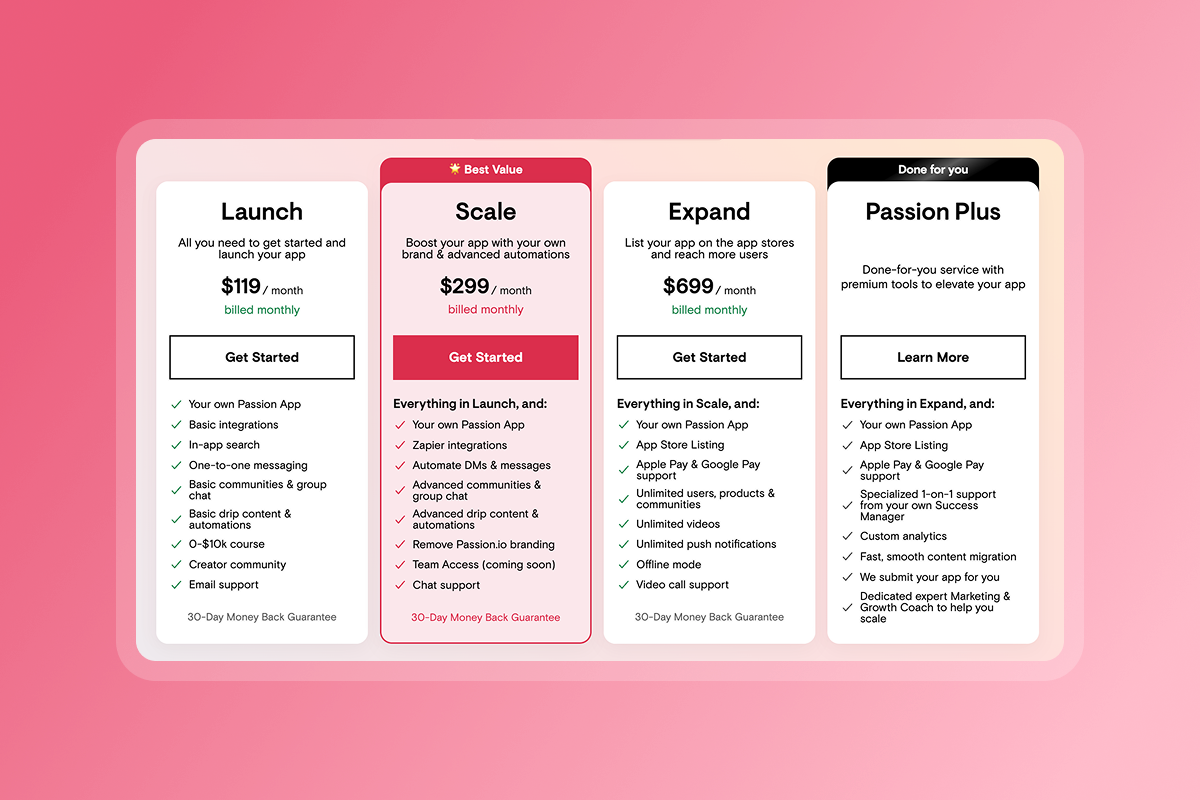
Passion.io pricing eliminates that overhead:
Launch Plan:
- $119/month monthly or $99/month billed annually
- Core features, web app, app store submission support
Scale Plan:
- $299/month monthly or $239/month billed annually
- Increased quotas, external checkout option
Expand Plan:
- $699/month monthly or $599/month billed annually
- Unlimited users, videos, communities, App Store Listing support
All plans include hosting, automatic updates, web app publishing, and access to the drag-and-drop builder. You're live in weeks, not months. Changes you make in the dashboard go live immediately without developer intervention.
Understanding the Fee Structure: Web vs. IAP
Transparency about fees builds trust. Here is what you actually pay:
Web Checkout via PassionPayments:
- 3.9% platform fee per sale
- Stripe's standard processing fee (~2.9% + $0.30)
- Total: ~6.8% + $0.30 per transaction
In-App Purchases (IAP):
- Apple and Google charge 15% for developers under $1 million in annual revenue
- 30% for revenue above $1 million
- Passion.io adds 0% platform fee on IAP transactions
- For subscriptions, Apple's commission drops from 30% to 15% after year one of continuous subscription
Developer Account Fees:
- Apple Developer Program: $99/year
- Google Play Developer: $25 one-time
External Checkout (Scale, Expand, Plus plans):
- 0% Passion platform fee when you process through approved external processors
- You pay only your external processor's fees
The fee structure gives you control. If you're selling a $297 course, losing $44.55 to Apple (15%) versus $20.26 to web checkout (6.8%) is significant. Route high-ticket sales to web. If you're selling a $9/month meditation app, IAP's one-tap convenience may convert better despite the higher fee.
Start with web checkout to maximize margin while you validate your offer. Once you have proof of concept and want to increase mobile conversions, add IAP. The flexibility to run both simultaneously is why the monetization model works for creators at different stages.
The ROI Framework: How to Calculate Your Break-Even Point
The mental model is simple. Write your monthly app cost. Write your membership price. Divide. That's how many members you need to justify the investment.
Formula: Monthly App Cost ÷ Average Revenue Per User (ARPU) = Members Needed to Break Even
Here's how this works at different price points:
| Monthly Membership Price | Launch Plan ($99/mo) | Scale Plan ($239/mo) | Expand Plan ($599/mo) |
|---|---|---|---|
| $29/month | 4 members | 9 members | 21 members |